
Como usar THERE IS e THERE ARE do jeito certo (sem errar mais)
Como usar there is e there are do jeito certo. Entenda a lógica real do inglês e pare de errar na hora de falar.
Aprender como usar there is e there are fica muito mais fácil quando você entende que essa estrutura serve para anunciar existência em inglês.
O problema não é decorar “is” e “are”. É entender o que essa estrutura faz
Você pesquisa como usar there is e there are porque, na hora de falar, trava.
Às vezes não sabe se usa is ou are.
Às vezes entende a frase quando lê, mas não consegue montar sozinho.
E muitas vezes o problema maior é este:
você ainda não entendeu a lógica por trás da estrutura.
Então aparecem frases como:
There have many people here ❌
There is two problems ❌
E isso mostra uma coisa importante:
o problema não é falta de regra.
O problema é falta de estrutura mental.
No Inglês em Teia, o aluno não aprende melhor decorando tabela.
Aprende melhor quando entende a função da construção.
O cérebro aprende padrão com função.
Hoje você vai enxergar there is / there are como um mecanismo de anúncio de existência.
Não como tradução mecânica.
Não como frase pronta sem lógica.
Mas como uma estrutura que o inglês usa para abrir a cena e mostrar o que está presente nela.
Se você já leu Como montar frases em inglês sem decorar regra, este artigo aprofunda um dos blocos mais importantes da estrutura básica. E ele também conversa diretamente com Quando usar AM, IS e ARE e Ordem das palavras em inglês, porque aqui você vai ver o verbo be funcionando dentro de uma ordem muito clara.
O que THERE realmente significa nessa estrutura
O primeiro ponto é este:
o there de there is / there are não é o mesmo “there” de lugar físico.
Ou seja:
nem sempre ele significa “lá”.
Veja esta frase:
There is a book on the table.
Aqui, o there não está apontando para um lugar como em “over there”.
Ele está funcionando como uma abertura de cena.
É como se o inglês dissesse:
- existe…
- tem…
- há…
Mas, estruturalmente, o idioma escolhe abrir com there + verbo be.
Essa é uma diferença importante.
THERE aqui é estrutura, não localização
Quando você diz:
There is a problem.
a lógica não é:
“lá é um problema”
A lógica é:
“existe um problema”
Esse ponto destrava muita coisa.
Porque o aluno para de tentar entender o there como lugar em todas as frases e começa a enxergar a função real dele:
abrir a cena para anunciar presença ou existência.
A lógica interna: anunciar que algo existe no cenário
O inglês organiza essa estrutura assim:
there + verbo be + coisa + complemento opcional
Exemplo:
There is a book on the table.
Vamos quebrar:
- there = estrutura de abertura
- is = forma singular do verbo be
- a book = aquilo que existe
- on the table = onde isso está
A pergunta central da estrutura é:
existe o quê?
Depois, se necessário:
onde?
ou
em que contexto?
Por isso essa construção é tão útil.
Ela não fala de posse.
Não fala de ação.
Fala de existência.
Estrutura básica de THERE IS / THERE ARE
A forma-base é esta:
There + is/are + substantivo + complemento
Exemplo com singular
- There is a book on the table.
Temos:
- there = abertura de existência
- is = singular
- a book = substantivo contável singular
- on the table = localização
Exemplo com plural
There are books on the table.
Agora:
- are = plural
- books = substantivo plural
- sem a, porque a/an só aparecem com singular contável
O ponto central aqui é:
o verbo concorda com o substantivo que vem depois.
Não é escolha aleatória.
É concordância estrutural.
Como os artigos funcionam nessa estrutura
Esse é um ponto muito importante, porque muita gente erra não só no verbo, mas também no substantivo que vem depois.
1. Contável singular e novo na cena → a / an
Exemplo:
There is a problem in the system.
Por quê?
Porque:
- problem é contável
- singular
- primeira menção
- ainda não específico no contexto
Se a palavra começa com som de vogal:
There is an error in my code.
Aqui usamos an porque error começa com som vocálico.
2. Específico → the
Exemplo:
There is the book you wanted.
Agora o livro não é qualquer livro.
É um livro específico, reconhecível pelo contexto.
Então usamos the.
3. Plural genérico → sem artigo indefinido
Exemplo:
There are books on the table.
Como books está no plural, não usamos a/an.
4. Incontável → sem artigo indefinido
Exemplo:
There is water in the bottle.
Water é incontável, então não entra a/an.
Perceba:
a estrutura continua a mesma.
O que muda é o tipo de substantivo.
Esse ponto conversa muito com a lógica de artigos que aparece em outros artigos do site: a estrutura continua viva, e o substantivo é que ajusta a forma.
Como escolher entre IS e ARE sem travar
Agora vamos para a parte que mais trava brasileiros.
A pergunta certa não é:
“qual parece mais bonito?”
A pergunta certa é:
o substantivo que vem depois é singular ou plural?
Singular → IS
There is a car outside.
There is a solution.
There is water here.
Plural → ARE
- There are cars outside.
- There are many people here.
- There are two problems.
Esse é o ponto central:
o verbo concorda com aquilo que existe.
Não com o there.
Não com o resto da frase.
Com o substantivo que vem depois.
Erros clássicos de concordância
Vamos olhar os erros mais comuns.
Erro 1: There is two problems. ❌
Errado porque:
- two problems = plural
- então o verbo precisa ser are
Forma correta:
There are two problems. ✔
Erro 2: There is many people here. ❌
Errado porque:
- people é plural irregular
- mesmo sem terminar em s, continua sendo plural
Forma correta:
There are many people here. ✔
Esse ponto é importante porque o aluno às vezes depende demais do “s final” e esquece que existem plurais irregulares.
Diferença entre THERE IS / ARE e HAVE
Esse é um dos erros mais importantes de todos.
Muitos brasileiros dizem:
There have many people here. ❌
Por quê?
Porque no português o “tem” aparece tanto para posse quanto para existência.
Mas o inglês separa essas funções com mais clareza.
HAVE = posse
I have a car.
Eu tenho um carro.
Aqui existe alguém possuindo algo.
THERE IS / THERE ARE = existência
There are many people here.
Há / existem muitas pessoas aqui.
Aqui ninguém está possuindo pessoas.
Você só está anunciando que elas estão presentes no cenário.
Essa distinção é muito importante.
Porque mostra como o inglês pensa por função:
- have = posse
- there is / there are = existência
Como as preposições entram na estrutura
O there is / there are não muda a lógica das preposições.
Elas continuam seguindo a relação espacial normal.
ON = superfície
There is a cup on the table.
A xícara está sobre a superfície da mesa.
IN = dentro
There is a cat in the room.
O gato está dentro de um espaço fechado.
AT = ponto
There are people at the door.
A porta funciona aqui como ponto de referência.
Perceba:
o there is / are abre a cena, mas quem organiza a relação espacial é a preposição.
Isso se conecta naturalmente com artigos de estrutura e preposição, porque a frase continua obedecendo à lógica normal do inglês.
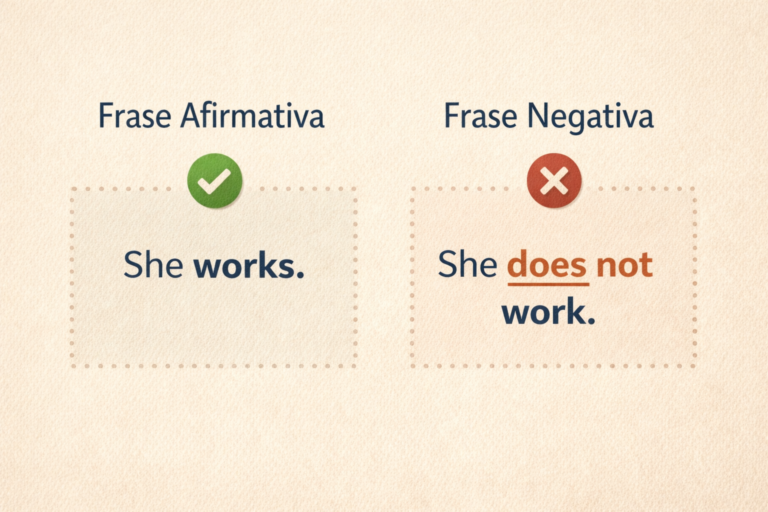
Negativa com THERE IS / THERE ARE
Agora vamos para a negativa.
Singular
There is not a problem.
ou
There isn’t a problem.
Plural
There are not any chairs.
ou
There aren’t any chairs.
Aqui aparece um ponto importante:
o uso de any é muito comum com plural ou incontável em frases negativas.
Exemplos:
- There aren’t any questions.
- There isn’t any water left.
Esse tipo de construção ajuda muito a deixar a frase mais natural.
Perguntas com THERE IS / THERE ARE
Na pergunta, o verbo vem antes de there.
Singular
Is there a solution?
Plural
Are there any questions?
A lógica é a mesma de outras perguntas com verbo be: o verbo vai para frente.
Exemplos:
- Is there a problem?
- Are there enough chairs?
- Is there any coffee left?
Um detalhe importante: singular e plural em listas
Esse ponto costuma confundir bastante.
Quando a frase começa com uma lista, o inglês muitas vezes faz a concordância com o primeiro elemento que vem depois do verbo.
Exemplo:
There is a book and two notebooks on the desk.
Muita gente estranha isso porque depois aparecem itens no plural.
Mas a concordância costuma começar pelo primeiro núcleo logo após o verbo.
Se vier plural primeiro:
There are two notebooks and a book on the desk.
Isso ajuda a entender por que às vezes a frase parece “quase plural”, mas começa com is.
Treino mental estratégico
Agora vamos treinar do jeito Inglês em Teia: por função e cena.
Cena 1: existe um erro no meu código
Frase:
There is an error in my code.
Por quê?
- error = singular
- som inicial de vogal → an
- in my code = localização dentro daquele contexto
Cena 2: existem três cadeiras na sala
Frase:
There are three chairs in the room.
Por quê?
- three chairs = plural
- sem a/an
- in the room = dentro do espaço fechado
Cena 3: existe água na garrafa
Frase:
There is water in the bottle.
Por quê?
- water = incontável
- verbo no singular
- sem a/an
Cena 4: existem pessoas na porta
Frase:
There are people at the door.
Por quê?
- people = plural irregular
- at the door = ponto
Esse tipo de treino é muito bom porque transforma a estrutura em algo visual, não em regra seca.
O erro do brasileiro: tentar traduzir “tem” sem separar função
Esse é o coração da confusão.
No português, “tem” pode servir para várias coisas:
- tem água aqui
- eu tenho um carro
- tem muita gente lá
- ele tem dois irmãos
O inglês prefere organizar isso melhor.
Então você precisa perguntar:
É posse?
Use have.
I have a car.
É existência?
Use there is / there are.
There is a car outside.
Quando o aluno aprende a separar isso, metade dos erros desaparece.
O que THERE IS / THERE ARE ensina sobre o inglês
Essa estrutura ensina uma coisa muito importante:
o inglês gosta de marcar função com clareza.
Em vez de deixar tudo misturado num “tem”, ele cria uma estrutura específica para abrir a cena e anunciar existência.
Isso mostra como a língua pensa:
- primeiro abre o quadro
- depois apresenta o que existe nele
É uma forma muito visual de organizar a frase.
E isso ajuda muito quem aprende melhor por cena e função.
THERE IS / THERE ARE é estrutura de existência, não frase para decorar
There is / there are não é um truque.
É uma estrutura muito lógica.
Você usa quando quer:
- abrir a cena
- anunciar presença
- mostrar que algo existe em um lugar ou contexto
O ponto central é este:
there = abertura da cena
be = existência
substantivo = aquilo que está lá
Quando você entende isso, para de decorar tabela e começa a montar frase com mais segurança.
Depois deste artigo, as continuações mais naturais são:
- Quando usar AM, IS e ARE
- Ordem das palavras em inglês
- Como montar frases em inglês sem decorar regra
- Frase afirmativa e negativa em inglês
- Erros mais comuns de brasileiros em inglês